

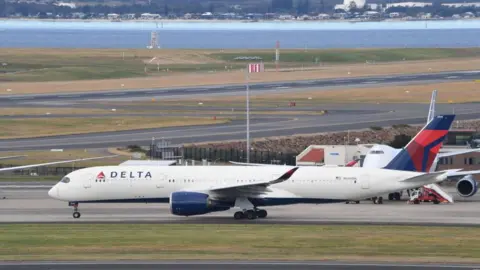
A number of individuals were hurt after a Delta aircraft from LA to Sydney, Australia experienced rough air this past Friday.
Delta Flight 41 "went through a short bout of rough air" as it touched down at the Sydney airport, an airline spokesperson told. Several cabin crew members required medical attention.
Local paramedics stated they treated a total of five people, and took three to a medical facility with non-life-threatening injuries that comprised spinal discomfort and headaches. The patients' ages ranged from their 30s up to the 70s.
The event represents the latest incident of commercial jets being hit by turbulence, with aviation specialists pointing out that climate change is a key driver.
There were nearly 250 travelers and fifteen staff members on the Airbus A350, the representative said, clarifying that the plane landed "safely" at Sydney Airport at 6:48 a.m. local time on the day in question.
The NSW Ambulance Service reported they received a call just three minutes ahead of the plane arrived, and ambulances were standing by on the runway.
The reasons turbulence is getting more frequent - and more severe.
In the previous year, two dozen individuals sustained injuries when a Delta Airlines flight, on a route from Salt Lake City to Amsterdam, Netherlands, hit "considerable" rough air just two hours into the transoceanic journey, and diverted for an emergency landing.
Recently, passengers and crew on a Singapore Airlines flight experienced a frightening five seconds bout of severe turbulence. One passenger lost their life and dozens were injured, as unbelted passengers rose out of their seats and were slammed back.
Turbulence is not uncommon on aircraft journeys, and while instances of rough conditions seem to be rising, they are statistically infrequent.
Estimates show that there are an estimated five thousand cases of significant in-flight disturbance each year, out of a sum of over 35 million aircraft departures that are conducted globally.
Strong atmospheric disturbance is categorized as when the vertical motions of a aircraft experiencing unstable air apply more than 1.5 times the force of gravity on your body - enough to throw you from your seat if you did not have on a safety belt.
As global warming alters atmospheric conditions, specialists caution that air travel could become less smooth: temperature changes and shifting wind patterns in the higher altitudes are expected to heighten the frequency and intensity of severe turbulence.
